In short
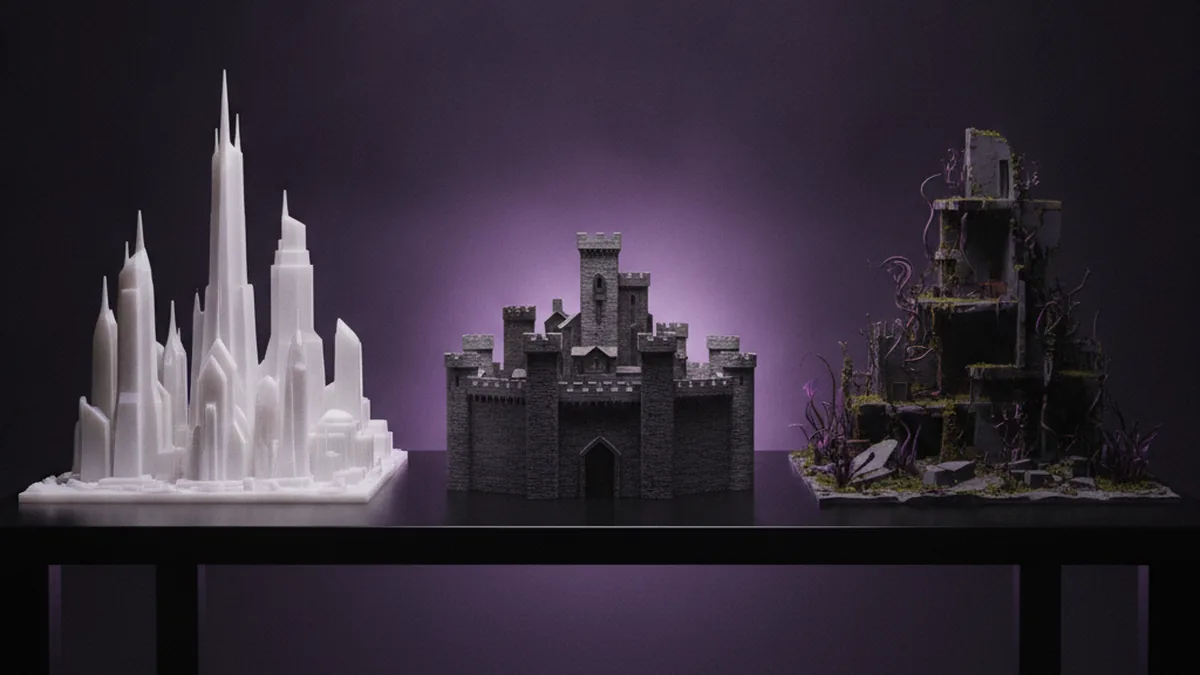
A utopia imagines a better society, a dystopia shows a society that fails its people, and a cacotopia is simply the worst place, with no pretence of order. Post-apocalyptic fiction usually starts outside all three and drifts toward one of them as survivors rebuild.
- Utopia is a pun: no place and good place
- Dystopia often wears the mask of a utopia
- Post-apocalyptic stories test which society gets rebuilt
Three words, three different claims
Readers and critics often use utopian, dystopian and cacotopian loosely, and sometimes interchangeably. The terms are more useful when kept apart. Each one makes a different claim about the imagined society: that it is better than ours, that it is worse while pretending otherwise, or that it is simply the worst. Knowing which claim a book makes helps you read it, and helps writers decide what their own story is arguing.
Utopia: the good place that is no place
The word comes from Thomas More's Utopia, published in Latin in 1516. More built it from Greek: ou-topos means no place, and it sounds almost the same as eu-topos, good place. The pun is the point. A utopia is an ideal society that does not exist, presented so that readers compare it with their own.
Utopian fiction is often less a story than a tour. Edward Bellamy's Looking Backward (1888) sends its narrator to the year 2000 and spends much of the book explaining how the new economy works. Ernest Callenbach's Ecotopia (1975) does something similar for an ecological society. The most admired modern example, Ursula K. Le Guin's The Dispossessed (1974), carries the subtitle An Ambiguous Utopia: its anarchist society on the moon Anarres is genuinely better in some ways and harsh in others, and the novel refuses to hide the cost.
Dystopia: the bad place that calls itself good
Dystopia is the more recent word. It is usually traced to a speech by John Stuart Mill in the British Parliament in 1868, where he used it as the opposite of utopia. In fiction, the most influential dystopias share a pattern: the society claims to have solved human problems, and the story shows the price paid by individuals.
- Yevgeny Zamyatin's We, written in the early 1920s, imagines a glass city where citizens are numbered and every hour is scheduled for the common good.
- Aldous Huxley's Brave New World (1932) offers stability through engineered birth, conditioning and pleasure. Hardly anyone suffers visibly, which is what makes it disturbing.
- George Orwell's Nineteen Eighty-Four (1949) relies on surveillance, propaganda and the control of language and memory.
- Ray Bradbury's Fahrenheit 451 (1953) burns books in the name of social harmony.
- Margaret Atwood's The Handmaid's Tale (1985) presents a theocratic order that claims to protect women while stripping them of rights.
In each case the regime would describe itself as a utopia. The dystopian novel shows the view from below.
Cacotopia: the worst place, with no disguise
Cacotopia comes from the Greek kakos, bad. The philosopher Jeremy Bentham used it in the early nineteenth century as the counterpart to utopia, a picture of the worst possible government. Anthony Burgess revived the word in 1985, his 1978 book that mixes an essay on Orwell with a short novel, and argued it was more precise than dystopia.
A useful working distinction, though not every critic draws it: a dystopia is a bad society with an official story about being good, while a cacotopia is bad and does not bother pretending. Burgess's own A Clockwork Orange (1962) is often read this way. Its streets belong to violent gangs, the state is brutal and cynical in return, and nobody claims this is paradise. The horror comes from disorder and cruelty rather than from a smooth, smiling system.
| Term | Literal meaning | Core claim | Classic examples |
|---|---|---|---|
| Utopia | No place / good place | A better society is possible | More, Bellamy, Le Guin, Callenbach |
| Dystopia | Bad place | A society that claims to be ideal harms its people | Zamyatin, Huxley, Orwell, Bradbury, Atwood |
| Cacotopia | Worst place | Society is openly bad, often chaotic or brutal | Bentham's coinage; Burgess's A Clockwork Orange and 1985 |
Where post-apocalyptic fiction fits
Post-apocalyptic fiction describes the world after a collapse: plague, war, environmental disaster or something stranger. At its starting point it is none of the three, because there is barely a society left to judge. That is what makes the genre interesting. The story often becomes an experiment in which kind of society the survivors will build.
Mary Shelley's The Last Man (1826) is an early example. George R. Stewart's Earth Abides (1949) follows a survivor watching a new, simpler culture form. Walter M. Miller Jr.'s A Canticle for Leibowitz (1959) traces a civilisation rebuilding across centuries and asks whether it will repeat its mistakes. Cormac McCarthy's The Road (2006) stays close to the cacotopian end, where what remains is mostly predation.
Massimo Marino's Daimones begins in this open space. Dan Amenta wakes to find humanity exterminated and his family spared, so the old order is gone and the new one is unwritten. Much of the trilogy's tension comes from that blank page: who decides the rules, and whether the survivors drift toward something better or something worse.
A quick test for readers and writers
- Does the society in the story exist yet? If not, you may be reading post-apocalyptic fiction that has not chosen its direction.
- Does the ruling order claim to be ideal? If yes and the story shows otherwise, it is a dystopia.
- Is the society openly violent or broken, with no official ideal? That leans cacotopian.
- Is the society presented as a real improvement, even with costs? That is a utopia, possibly an ambiguous one.
- Whose eyes do we see it through? Utopias are often seen by visitors, dystopias by insiders who start to doubt.
Why the distinctions matter
Labels are not rules, and many great books sit between categories. Le Guin made ambiguity the subject of her utopia, and plenty of dystopias contain moments of real comfort. Still, the three terms point to different questions. Utopia asks what we could become. Dystopia asks what we are told and what it hides. Cacotopia asks what happens when nobody even pretends. Post-apocalyptic fiction clears the board and asks which of those answers people will choose.
Every utopia is a proposal, every dystopia a warning, and every ruined world in fiction a choice that has not been made yet.
For writers, the choice of mode also shapes structure. Utopias tend to need a guide character and a newcomer who asks questions. Dystopias usually follow an insider whose doubt grows into resistance, which gives a natural plot arc. Cacotopias are often episodic and focused on survival, because there is no central system to rebel against. Post-apocalyptic stories begin with survival and then, if they last long enough, turn into arguments about politics, which is why so many of them become series rather than single novels.
Questions
What is the difference between dystopia and cacotopia?
In the working distinction used here, a dystopia is a bad society that presents itself as good, while a cacotopia is openly bad, often chaotic or brutal. Many critics use the words interchangeably.
Who coined the word utopia?
Thomas More, in his book Utopia, published in 1516. The name combines Greek roots meaning no place and sounds like the Greek for good place.
Is post-apocalyptic fiction the same as dystopian fiction?
No. Post-apocalyptic fiction is about the world after a collapse. It may develop into a dystopia, a cacotopia or even a hopeful rebuilding, depending on what the survivors create.

Independent reader guides, science notes and writing craft.